helgoland(1)
This post is ultimately about a radio programme, heard on BBC Radio 4 (on 31st Dec 2025), What is Quantum?
But first, Helgoland.
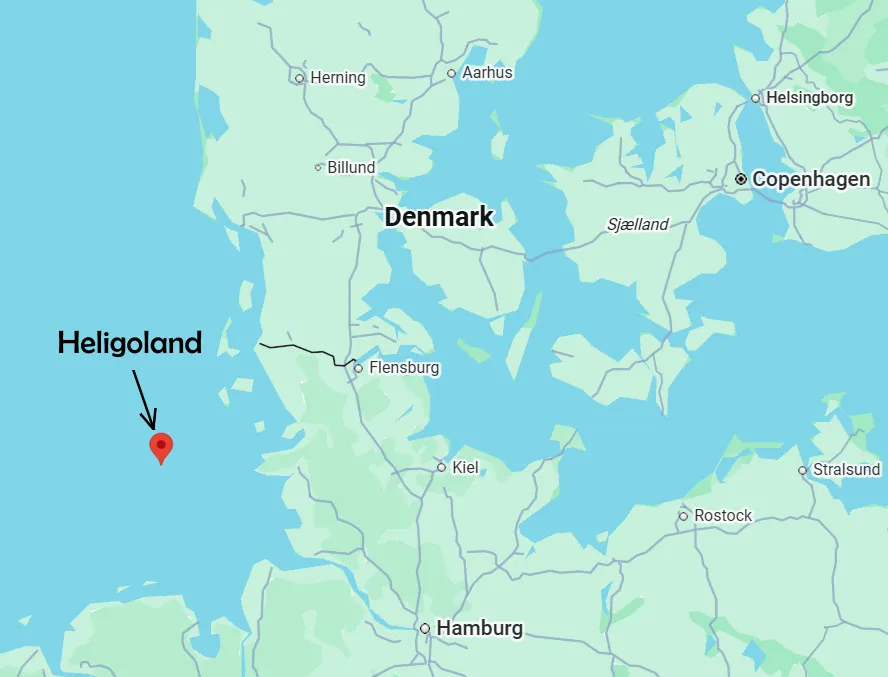
Helgoland (or Heligoland) comes into Werner 'Uncertainty' Heisenberg's life story. I first learnt about this in Heisenberg's fascinating and highly influential (on me, that is!) book Physics and Beyond (1969). He was having a bad bout of hay-fever, in May 1925, he says, and took himself off to the small tree-less island of Helgoland. Until now, I had only vaguely wondered about where Helgoland actually is, and what it consists of. Denmark comprises a peninsula (Jutland) sticking out from Northern Germany into the North Sea, and guarding the entrance to the Baltic Sea, together with various islands, most importantly Zealand which contains Copenhagen and almost abuts Sweden. But the base of the Jutland peninsula is a region of Germany, Schleswig-Holstein. The island(s) of Helgoland (=possibly heilig-Land, holy land) lie to the West of Schleswig-Holstein, about 30 miles out to sea.
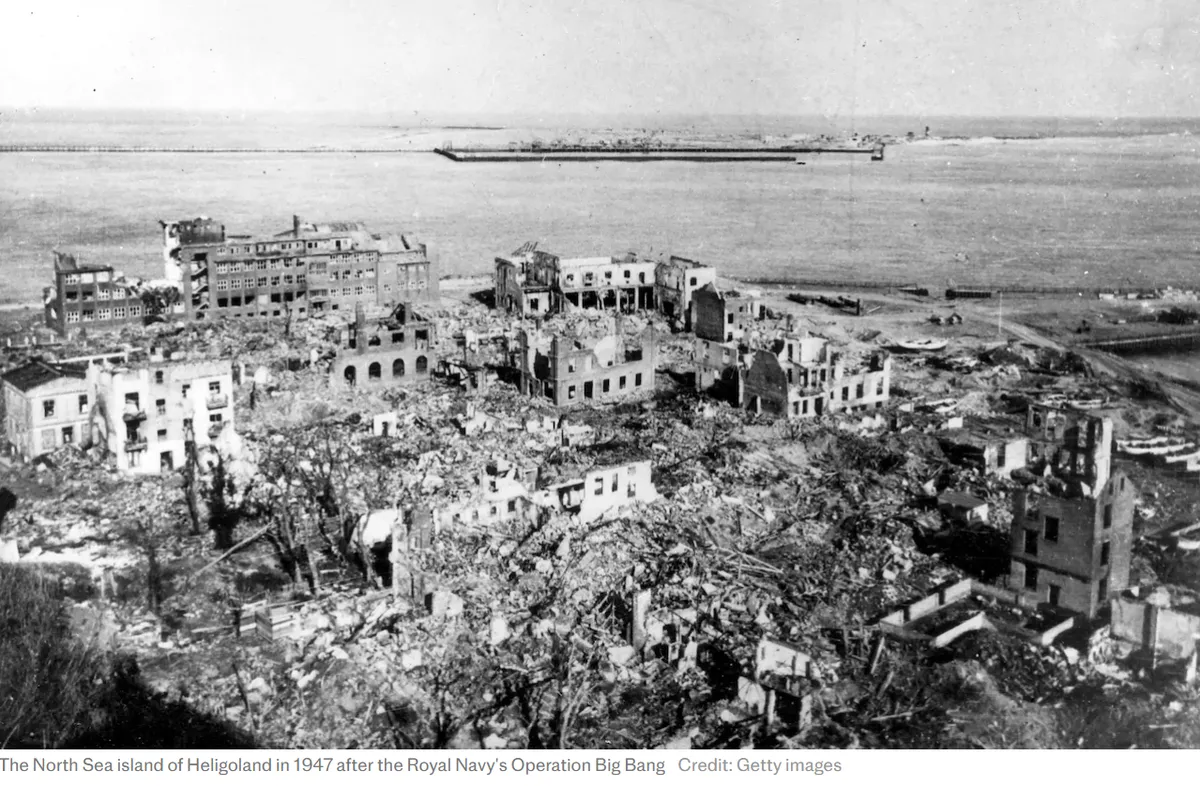
Helgoland is tiny (1.6 square miles), with a chequered history. A British possession for most of the 19th century, it then became German, and was used as a German naval base. From 1945 to 1952 the island was uninhabited and back under British control. In April 1947 it was blown (intentionally) almost to smithereens by an enormous explosion of TNT from surplus ammunition. Then in 1952 the inhabitants began creeping back.
Back to Heisenberg... at the time of his hay-fever episode he was deeply engaged in the project to invent a new 'quantum mechanics', which would somehow be based only on 'observable quantities' (i.e. the frequencies and intensities of the spectral lines emitted by atoms) as opposed to the hypothetical 'orbits' of electrons within those same atoms. Each spectral line is associated with a transition from one 'stationary state' of the atom to another, so it is natural to arrange the lines in a square table or matrix (where the rows correspond to the atom's initial state, the columns to the final state, after the emission).
The fresh air of helgoland helped sort it all out in Heisenberg's mind, it seems, and in one particular late-night session he got his new mechanical scheme to work in a very simple example (the so-called Simple Harmonic Oscillator). This was the birth of what later came to be called 'matrix mechanics'.
As an aside, matrix mechanics, although correct, never became easy and transparent, and was largely superseded by Schrödinger's much better wave mechanics -- but Heisenberg got there first. Both matrix mechanics and wave mechanics are now regarded as versions of an underlying scheme called 'quantum mechanics', so Helgoland is associated with the birth, not only of matrix mechanics, but of quantum mechanics more generally.